As any seasoned traveler knows, the battle against wrinkled clothing begins the moment you unzip your suitcase. You arrive at your destination full of excitement, only to be met with a crumpled mess that looks more like a laundry pile than a vacation wardrobe. For decades, the standard method has been to neatly fold each garment, stacking them like a retail display. This technique, while orderly, is fundamentally flawed when it comes to preventing the deep-set creases that can ruin the look of your favorite outfits. The creases formed by sharp folds are pressed into the fabric for the duration of the journey, often requiring a steamy bathroom or a costly hotel pressing service to erase.
The frustration of unfolding a suitcase to find a landscape of wrinkles is a universal travel experience. It’s a problem that has spawned an entire industry of wrinkle-release sprays, portable steamers, and specialized packing gadgets, all promising a solution. Yet, the most effective technique might be the simplest and requires no special equipment at all. It’s a method that challenges our ingrained habits of neatness and order, proposing that a slightly messier-looking suitcase is actually the key to arriving looking polished and put-together.
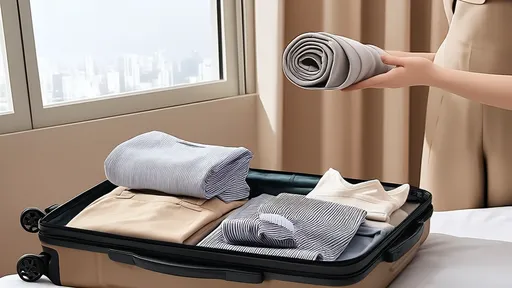
Enter the art of rolling. This technique isn't a new, space-age invention; in fact, it's been used by military personnel and savvy backpackers for years to maximize space and minimize damage to their gear and clothing. The core principle is brilliantly simple: by rolling your clothes, you eliminate the harsh, permanent creases that folding creates. Instead, you introduce gentle, curved folds that are far less likely to set deeply into the fabric's fibers. The result is that when you unroll a shirt or a pair of trousers at your destination, the fabric naturally falls back into shape with significantly fewer wrinkles.
So, why does rolling work on a mechanical level? It all comes down to physics and fabric tension. When you fold a garment, you create a few concentrated points of high pressure—the sharp edges of the fold. These points bear the full weight of the clothing stacked above them, crushing the fibers and creating a stubborn crease line. Rolling, conversely, distributes pressure more evenly across the entire surface of the garment. The tension of the roll itself helps to smooth out the fabric, and because the resulting bundle is cylindrical, any pressure from other items in the suitcase is applied across a broader, curved surface, preventing deep indentation.
The benefits of this method extend beyond just wrinkle reduction. Rolling is a phenomenal space-saver. By tightly compressing each item, you can fit significantly more into your luggage, leaving precious room for souvenirs on the return trip. It also offers superior organizational capabilities. Instead of digging through layers of folded clothes to find one specific item buried at the bottom, you can line up your rolled garments like a library of clothes, seeing every item at a glance. This makes unpacking and selecting an outfit a breeze, transforming your suitcase from a black hole of disorder into an efficient, modular storage system.
Mastering the roll does require a slight technique adjustment for different types of clothing. For t-shirts, cotton blouses, and casual trousers, lay the item flat, smooth out any existing wrinkles with your hands, and then roll from the bottom hem upward, keeping the roll as tight and even as possible. The final bundle should be firm but not so tight that it strains the seams. For more delicate items like silk blouses or dresses, a looser roll is advisable to prevent stretching. For structured items like blazers or suit jackets, a hybrid approach is best. These should be folded as little as possible—ideally just once, along the natural seam of the shoulders—and placed on top of your rolled items to avoid being crushed.
To achieve packing nirvana, combine rolling with other smart strategies. Think of your suitcase as having zones. Start by placing your shoes (in dust bags) and any other hard, heavy items at the bottom, near the wheels. Then, begin packing your rolled garments, filling in the gaps and crevices between these larger objects. Use the interior packing cubes or compartments of your suitcase to separate categories of clothing or to keep rolled bundles neatly contained. Finally, place any items that are prone to wrinkling or that you’ll need first—like a jacket or a nice outfit for dinner—on the very top layer.
The true test of any packing method is in the arrival. Those who convert to rolling often report a moment of revelation upon unpacking. Instead of the usual frustration, there's a sense of triumph. Garments emerge from the suitcase soft, pliable, and remarkably smooth. A quick shake and maybe a brief hang in the steamy bathroom is often all it takes to restore them to a perfectly wearable state. This simple shift in technique can save valuable vacation time and money, freeing you from the hunt for an iron or the need to wait for hotel service.
Ultimately, rolling your clothes is more than just a travel hack; it's a smarter, more efficient philosophy of packing. It prioritizes the well-being of your garments and the practicality of your journey over the superficial neatness of a folded stack. It acknowledges that a suitcase is a dynamic environment where items shift and settle, and it uses that movement to its advantage rather than fighting against it. So, on your next adventure, resist the urge to fold. Embrace the roll, and step off your flight ready to explore, not iron.

By /Aug 20, 2025

By /Aug 20, 2025

By /Aug 20, 2025

By /Aug 20, 2025
By /Aug 20, 2025

By /Aug 20, 2025

By /Aug 20, 2025

By /Aug 20, 2025
By /Aug 20, 2025
By /Aug 20, 2025

By /Aug 20, 2025

By /Aug 20, 2025

By /Aug 20, 2025

By /Aug 20, 2025

By /Aug 20, 2025

By /Aug 20, 2025

By /Aug 20, 2025

By /Aug 20, 2025

By /Aug 20, 2025

By /Aug 20, 2025